AI in practice
Build or buy decision intelligence: can't we just build this with Claude Code?
Can your team build decision intelligence in-house with Claude Code? What a build costs in time to accuracy and lost decision history, and when it wins.
· 13 Nov 2026 · 7 min read
Yes, your team can build decision intelligence with a coding agent like Claude Code, and the real question for the build-or-buy meeting is what they stop building while they do. Other costs seldom reach the spreadsheet either: accuracy takes years to earn, and a record of your decisions only starts once something is running.
In a brand workshop in July, talking through the questions buyers would put to us, this was the one I said mattered most. My sketch of the reply still had the placeholders in it: “Well, no, you can’t because of X, Y and Z.” The transcription software heard Claude Code as “clock code”. Filling in X, Y and Z properly starts with a concession, because most of the teams who ask have engineers who could build a working version, and plenty of them are already partway through one.
How often do buyers ask whether they can build decision intelligence in-house?
About 10% of the businesses we spoke to over the past year raised it. CTOs and data leads asked it most, and the majority were already building.
A loyalty business running Snowflake had its own data science team partway through a next-best-action project and wanted to know why we would do better than the people already working on it. A pharmaceutical wholesaler was building quickly in-house alongside a large consultancy. An insurer’s data team challenged us on where Unloq overlapped with Databricks agents, a creative agency group was building its own AI brain, and a private equity investor told us some of its portfolio companies were already building internally. If you are reading this with a prototype already running, you are in good company. For what the category covers, start with what decision intelligence is.
What can your team build with Claude Code?
An engineer with a coding agent can wire a chat interface to company data in days, and it will demo well. Somebody types “what was revenue in the north last quarter?”, a number comes back, and the room is impressed. What a board trusts is everything around the model: definitions the business has agreed, a check on every figure before anyone sees it, access enforced on each query, and an audit trail someone in finance can follow back to the rows. The same gap shows up when teams use a model on its own, which we cover in what decision intelligence adds to Copilot or ChatGPT.
Modus Create surveyed 550 product and technology leaders and found that nearly half make build-versus-buy decisions based on the availability of internal skills. A coding agent pushes that further, because it makes every team feel skilled enough. Their sharper point is that much of what organisations call building is really blending: integrating models, tuning prompts, orchestrating workflows and layering interfaces on top of third-party systems.
We half-agree with Modus, since the model stays external in nearly every build we see. Where we disagree is the suggestion that blending is a lesser kind of building. Modus counts governance logic and evaluation layers as blending work, and in our experience working with clients, that layer is where most of the cost of a decision system sits, and most of the years.
When should you build it yourself?
Build it yourself if any of these describes you.
Analytics is the product you sell. The decision layer is then your differentiation, and you should own it.
The tool is narrow and low-stakes, and nobody expects it to last. A chat over one dataset for one team for one quarter is a fine thing to build.
You already have a decision-science team with the capacity to maintain the system for years.
A senior person wants to build certain workflows personally, and the value lies partly in what they learn by doing it.
The failure mode is scope creep. The narrow tool works well enough that it gets asked to feed bigger decisions and touch more sensitive data, and the governance that was skipped at the start becomes the project, discovered under deadline or after a wrong number got through.
We cannot settle one thing here: a team that builds its own version learns things about its data that a team that buys never has to, and some of that knowledge outlasts the tool. We have no way to put a price on it, and we would distrust anyone who said they could, ourselves included.
Why does accuracy take longer than the code?

In-house builds typically start at around 50 to 55% accuracy and take years to climb. Unloq’s newer results run at 85% today.
The gap comes from rules that are written down nowhere. A first version turns a question into SQL against the tables as they stand, and it gets most simple lookups right. It goes wrong where the answer depends on something the business knows that never made it into the schema: revenue that finance reports net of credit notes and sales reports gross, a regional boundary redrawn in March, a customer counted twice because they buy through two entities. Each fix is small, and finding them takes the time, because each one only surfaces when somebody senior looks at a number and says it cannot be right, and by then they have stopped trusting the tool a little.
So the method matters as much as the model. Unloq computes every figure in code from your data. Unloq then checks each figure against the SQL that produced it and validates it against the business rules, and every answer is marked pass, warn or block before anyone sees it. A blocked answer is stopped at that gate, before delivery. That is how Unloq checks every figure.
What does your team stop building while it builds this?
The biggest cost of building AI in-house is the roadmap: the team stops building whatever was next on it, and keeps not building it for as long as the system needs maintaining. Sean Michael Kerner’s decision matrix for CIOs in TechTarget notes that development time and upfront costs run higher than most projections, and that maintenance and model updates compound the cost beyond the first build.
The maintenance list for a decision system is specific. Someone owns the semantic layer and changes it every time finance changes a definition. Someone re-checks the access controls at each security review, and someone recalibrates when the business reorganises. In a mid-market business those jobs land on the data engineers who were meant to be doing something else.
Put the roadmap next to the build plan and name the two items that get pushed back.
Why does every month of building cost you decision history?
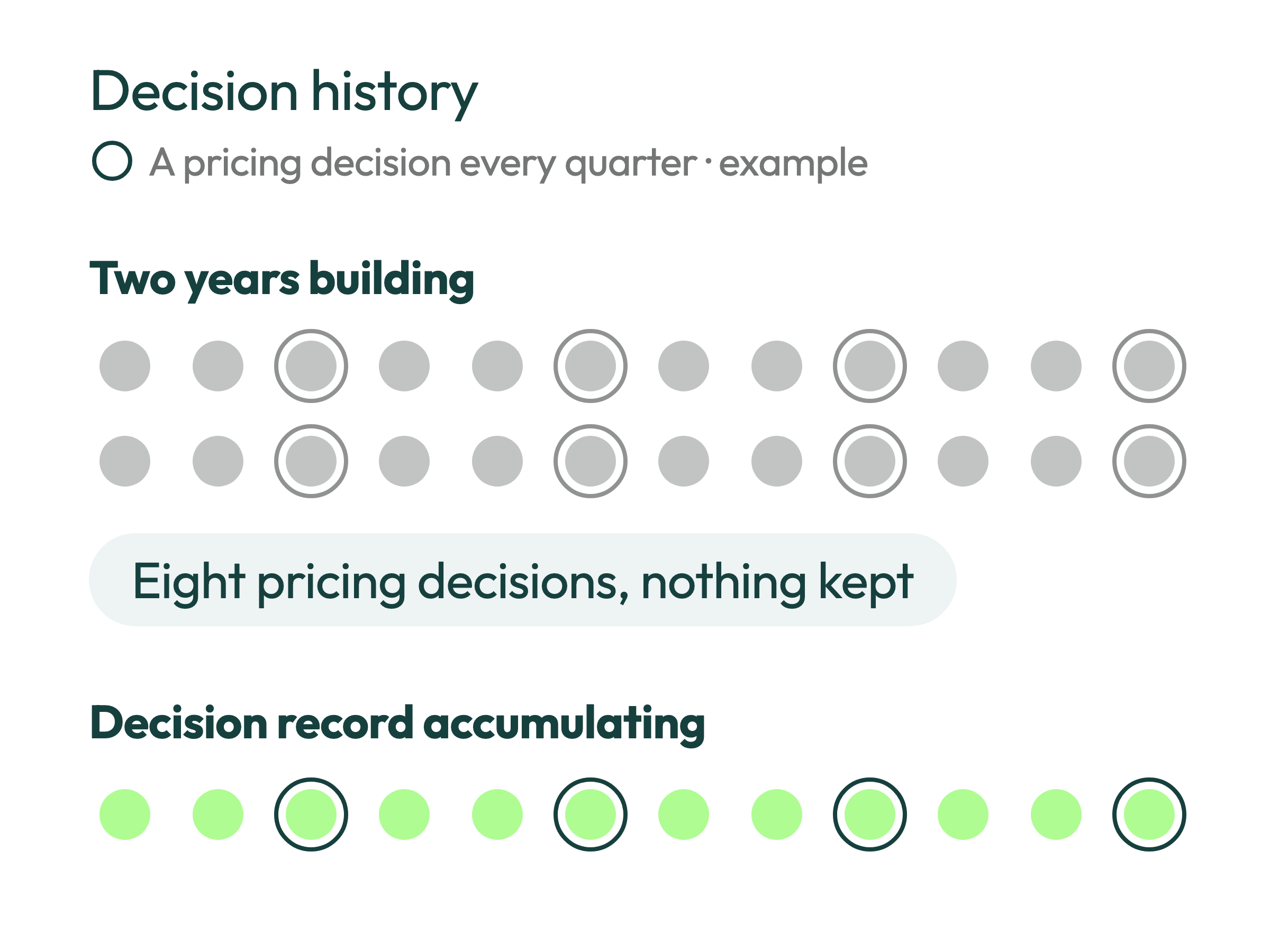
A decision record (what was recommended, what was decided and what happened) only accumulates once something is running, so a month spent building is a month of history you do not get back. If your leadership team reprices every quarter, two years of building is eight pricing decisions with nothing kept about why they were made or how they turned out.
That history is the thing that compounds. The value of a decision system grows with the number of past calls it can compare against, because the next recommendation can be checked against what happened last time. A build plan measured on delivery dates has no line for it, and the cost never appears on anyone’s budget, which is why it seldom comes up in the build-or-buy meeting. You can read more about why so few businesses keep a record of their own decisions.
How do you compare build vs buy for decision intelligence fairly?
Compare them over the whole life of the system, pricing in maintenance and lost history, and ask the same questions of your own team that you would ask a vendor.
Build it | Buy the decision layer | What to ask | |
|---|---|---|---|
Time to a first version | Days for a demo with a coding agent | Depends on scope | How long until one real decision is answered on our data? |
Time to trusted accuracy | Typically starts at around 50 to 55% and takes years to climb | Unloq’s newer results run at 85% | What accuracy do we need before a board will act on it? |
Maintenance | Yours, for as long as the system runs | The vendor’s, with your team owning the definitions | Who maintains this in year three? |
Governance and audit | Built by you, commonly after the first version | Each answer arrives with its checks and its trail | Can finance trace a figure back to the rows that produced it? |
Opportunity cost | The roadmap items your team moves to make room | Your team stays on its roadmap | Which two items get pushed back? |
Decision history | Starts when the build ends | Starts when the first decision runs | How many decisions will we make before it is running? |
The answer we give most often sits between the two columns: buy the decision layer and keep your data platform. The models stay with your team, and Unloq is the production decision system around them.
Where can you see this in Unloq?
On the platform page, each Unloq answer carries the plan, the SQL that ran, the documents used with page and excerpt, the aggregation logic and the validation status. Unloq works above the data platform you already run with read-only access, so the warehouse and everything your team built on it stays where it is.

Written by
Co-founder and CEO, Unloq
Yiannis has spent 20 years in AI and technology. He founded Birmingham Tech Week and grew a business from £500K to £22M in recurring revenue before selling it in 2017. He was made an MBE for services to technology and holds an honorary doctorate from Aston University, where he is AI Entrepreneur in Residence.
Questions we get asked
Got a question about this?
Send it to us and one of the team will come back to you with an answer.
Ask a question

