AI in practice
What does decision intelligence add to Copilot or ChatGPT?
About 8% of the businesses we spoke to last year asked us this. What decision intelligence adds to Power BI, Copilot and ChatGPT Enterprise, and when not to buy it.
· 13 Oct 2026 · 7 min read
Decision intelligence adds a governed layer between your data and the decision: every metric fixed to one agreed definition, every answer carrying the calculation and the sources behind it, and a plain statement when the data runs out. Copilot and ChatGPT Enterprise are very good at helping a person work faster with their own documents and data, and for a lot of work that is all a business needs.
About 8% of the businesses we spoke to over the past year put this question to us, from a business bank to an architecture practice. The architecture practice said it most plainly: we already have Copilot, so why do we need more software?
What do Copilot and ChatGPT already do well?
Copilot and ChatGPT Enterprise do a lot well, and on data protection the enterprise versions are strong.
Microsoft says Copilot only surfaces organizational data to which individual users have at least view permissions, and that prompts and business data aren’t used to train foundation LLMs. That page also notes, in passing, that Microsoft 365 Copilot is now named Microsoft Copilot. Admins can search and retain Copilot interactions in Purview, EU traffic stays within the EU Data Boundary, and in the Fabric data agent row-level and column-level security still apply. The Fabric data agent answers plain-English questions across up to five data sources, read-only. On the OpenAI side, the company states that, by default, it does not train its models on business content from ChatGPT Enterprise or ChatGPT Business.
For drafting a board paper, summarising a contract or a one-off look at a spreadsheet, a frontier model on its own is fine.
What does Microsoft say Copilot needs before it answers well?
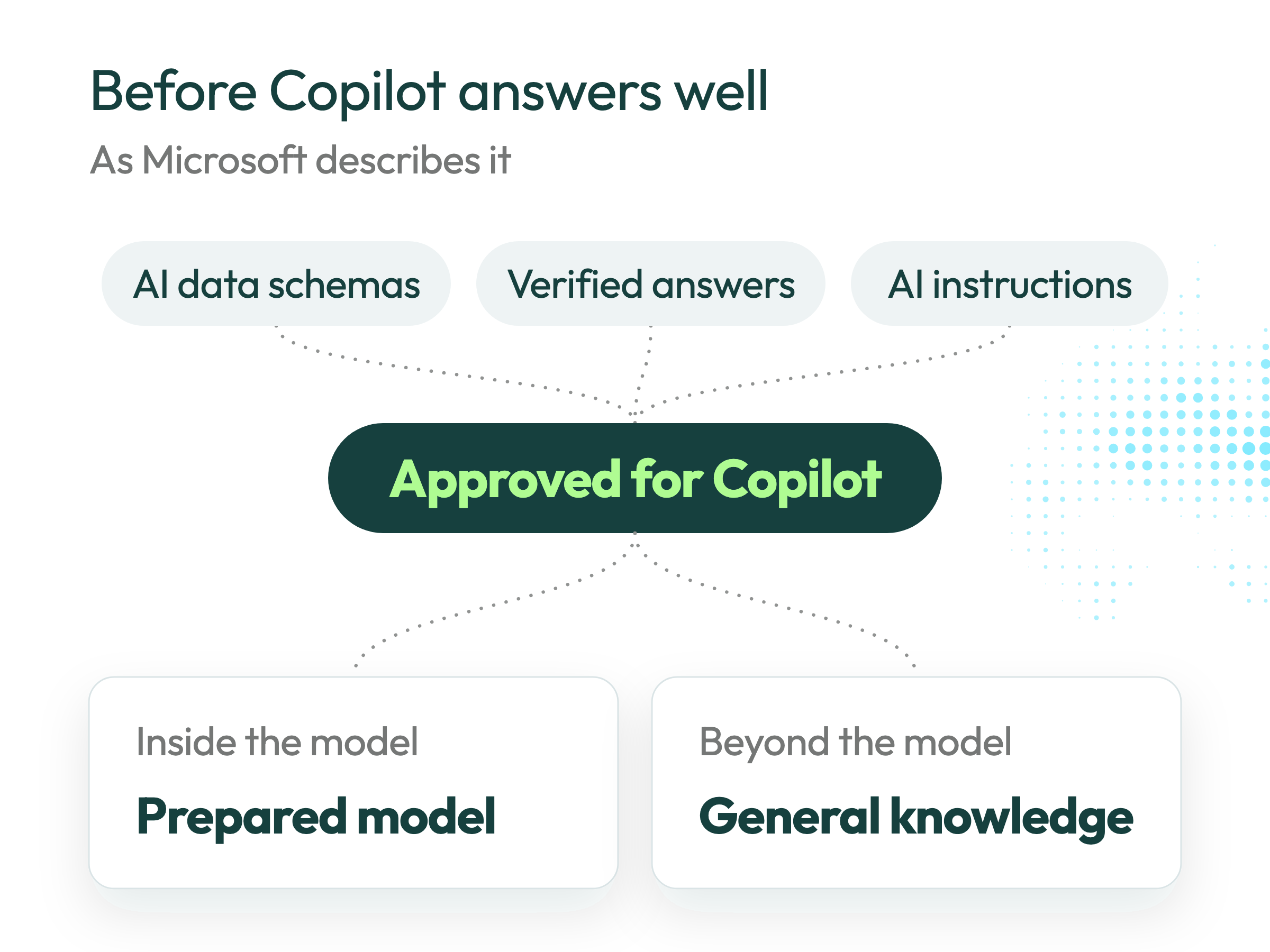
Copilot needs a prepared data model, and Microsoft’s Power BI documentation is direct about what happens without one: Copilot can misinterpret the data and return generic or inaccurate results. The preparation it describes is real work. Teams write AI data schemas, verified answers and AI instructions, then mark the model “Approved for Copilot”. When a question goes beyond the prepared model, Copilot answers from the large language model’s (LLM) general knowledge.
We half-disagree with Microsoft on the size of the job. In our experience working with clients, the hard part is governance: deciding what “active customer” means when finance and sales count it differently, and changing that definition when the business changes. So the buying question becomes who writes and maintains the agreed definitions, and what happens when a question goes beyond them.
Unloq’s answer is a semantic layer co-authored with your team, with every change kept as a new version. Unloq resolves each question against those definitions as it runs, and when the data cannot support an answer, Unloq says where it stops. You can see how Unloq handles missing data.
We have not found a way to make the definition work disappear. Whatever you buy, someone in your business has to own it, and when finance and sales disagree about a number, no software decides who is right.
How do Copilot, ChatGPT and decision intelligence compare on a decision with money attached?
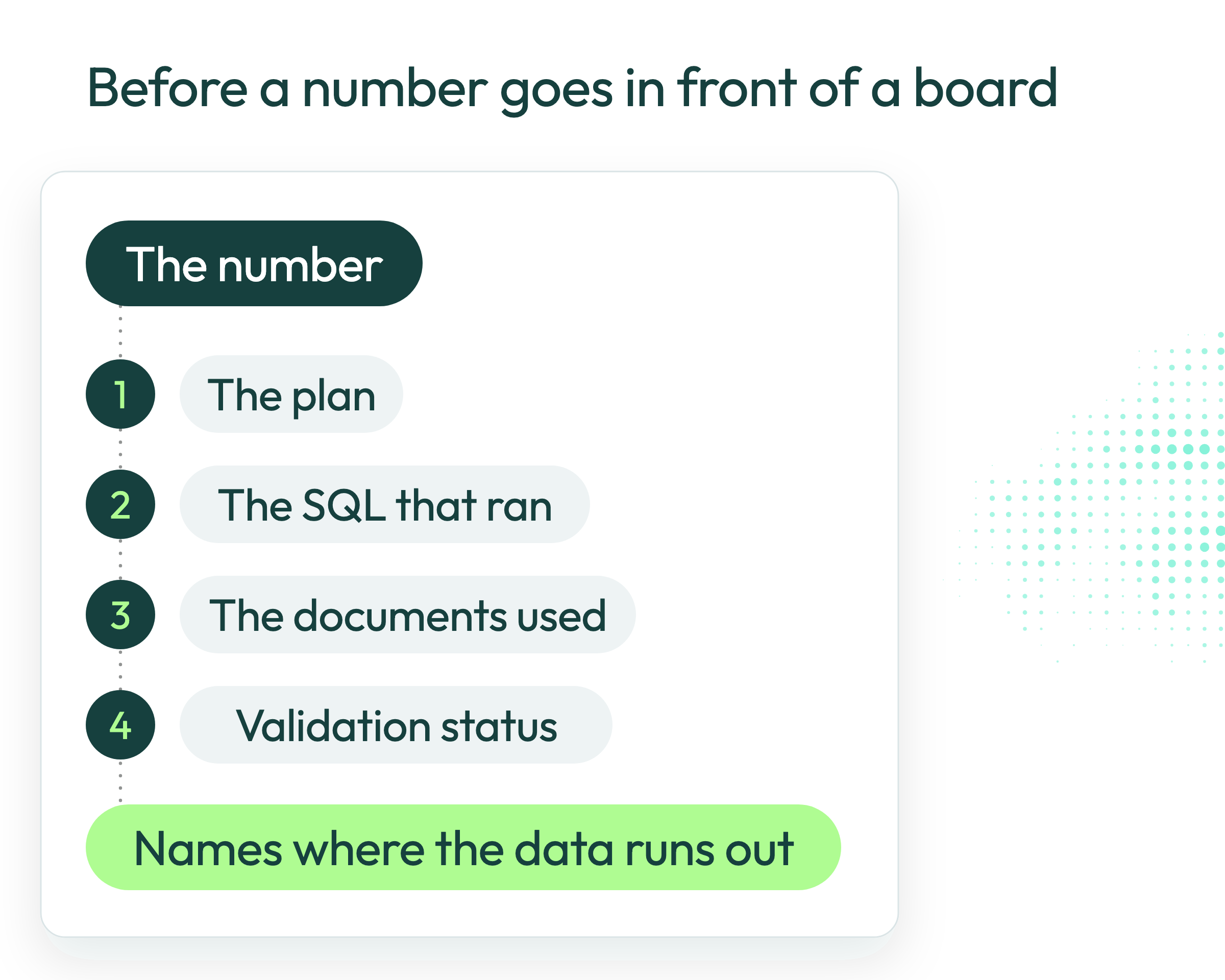
On where the data goes, Copilot and ChatGPT Enterprise hold up well; the difference shows on where an answer came from and on what the system does when the data runs out. Before a number goes in front of a board, we put any AI tool through one set of checks, Unloq included.
Test | Copilot and ChatGPT Enterprise | What decision intelligence adds |
|---|---|---|
Where does the data go? | Strong. Copilot respects each user’s permissions. Microsoft and OpenAI both exclude enterprise business content from model training | Little on this test. The exposure we look for first is the personal ChatGPT account and the exported spreadsheet |
Where did the answer come from? | The plan, the SQL that ran, the documents used with page and excerpt, the aggregation logic, and a validation status on every answer | |
Does the system say when it does not know? | Outside its prepared model, Power BI Copilot answers from general knowledge | Unloq names where the data runs out, and would rather show nothing than a confident wrong answer |
For the first test, the leak we would look for in most businesses is somebody pasting a customer list into a personal account because the approved tool was slower, and no platform purchase fixes that.
On the second test, a finance director checking a margin figure wants the query that produced the number, the rows it summed, and whether the result passed the business rules. Unloq checks every figure against the SQL that produced it before the answer is shown, validates it against the business rules, and marks it pass, warn or block.
With the third test, the risk is a question like “what was our EBITDA margin in the north last quarter?”, which sounds simple and can only be answered from your own data. A data adviser to a construction firm’s board put the choice to us in nearly those terms: a governed system should admit when the data is insufficient, because a confident answer nobody can check is the bigger risk. The decision layer in Unloq names where the data runs out before anyone acts on the figure.
Why are “what is the number?” and “why did it move?” different questions?
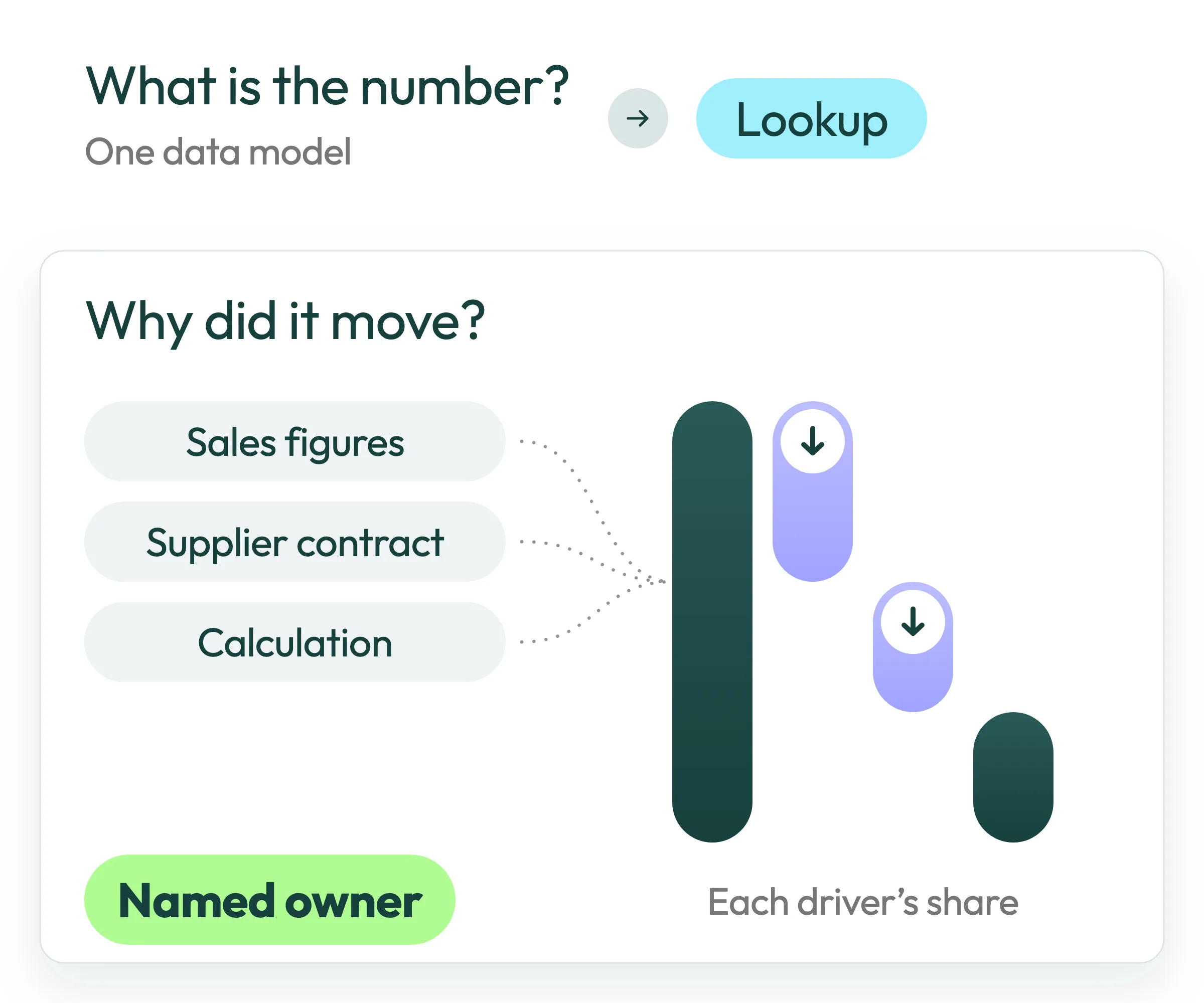
“What is the number?” is a lookup, and “why did it move?” needs numbers, documents and a calculation together. Microsoft describes the Fabric data agent as the conversational analytics component of a larger system, which is a fair description. Its documented limits follow from that role: it does not read PDF, Word or text files, it draws on up to five sources, and answers are capped at 25 rows and 25 columns. For “what was revenue by region last quarter?” those limits never get in the way.
When margin falls in one region, the answer needs the sales figures, the supplier contract that changed in March, the share of the fall each driver accounts for, and a named person who owns what happens next. Microsoft 365 Copilot reads documents too, and a capable team can stitch the pieces together by hand.
Unloq brings the numbers and the documents into one cited answer, and works out each driver’s share of the movement in SQL before showing it as a waterfall, so the split is a calculation anyone can rerun. That is how Unloq shows why a number moved. Satyen Fakey, our CTO, walks through the method in why dashboards don’t explain why numbers changed.
Does Copilot give the same answer to the same question twice?
Copilot does not always answer a repeated question identically, and Microsoft says so: its own guidance describes AI behaviour as nondeterministic. Within a rolling 24-hour window, Power BI Copilot responds from the cache, so a prompt repeated word for word on an unchanged model within that window gets an identical response.
One business put the result to us as two analysts, two stories. In Unloq the definitions are fixed before any query runs, and deterministic code produces every figure. We have not run a consistency comparison against Copilot and we make no claim about one.
When should you not buy decision intelligence?
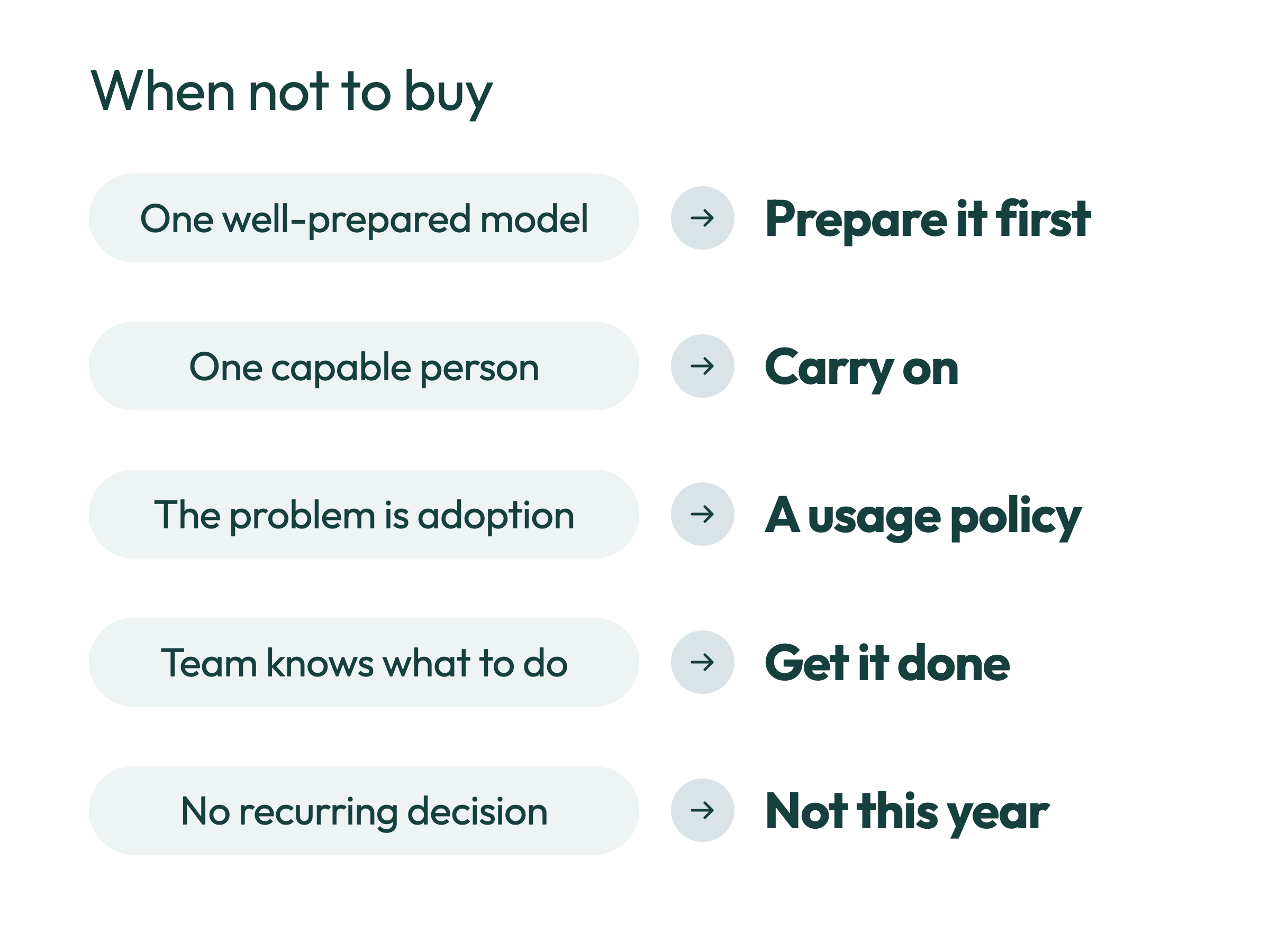
You should not buy decision intelligence when the tools you own already answer the questions you have. In those cases we would say so on the first call.
Your questions are answered from one well-prepared data model. Do the preparation Microsoft describes, mark the model approved, and see how far it takes you before spending more.
One capable person does the analysis. We have met a finance leader getting real value from a frontier model on his own, and he should carry on.
The problem is adoption. If people are not using the tools you have already bought, start with a usage policy and a working group.
Your team already knows what to do and the hold-up is getting it done. Better information will not move that.
There is no recurring decision with money attached, or no budget this year.
Where does Unloq fit with what you already run?
Unloq works above the stack you already run, with read-only access, so Power BI keeps doing the reporting and Copilot keeps doing the drafting. Our engineering team also builds on Microsoft directly: on the IM Group delivery we reviewed more than 5,000 custom data fields in a Microsoft Fabric and Azure build. We set the two products side by side in Unloq and Power BI with Copilot compared.
The test we would rather run than argue about is one of your own decisions, answered side by side with what you use now.

Written by
Co-founder and CEO, Unloq
Yiannis has spent 20 years in AI and technology. He founded Birmingham Tech Week and grew a business from £500K to £22M in recurring revenue before selling it in 2017. He was made an MBE for services to technology and holds an honorary doctorate from Aston University, where he is AI Entrepreneur in Residence.
Questions we get asked
Got a question about this?
Send it to us and one of the team will come back to you with an answer.
Ask a question