Sep 4, 2026
What is decision intelligence?
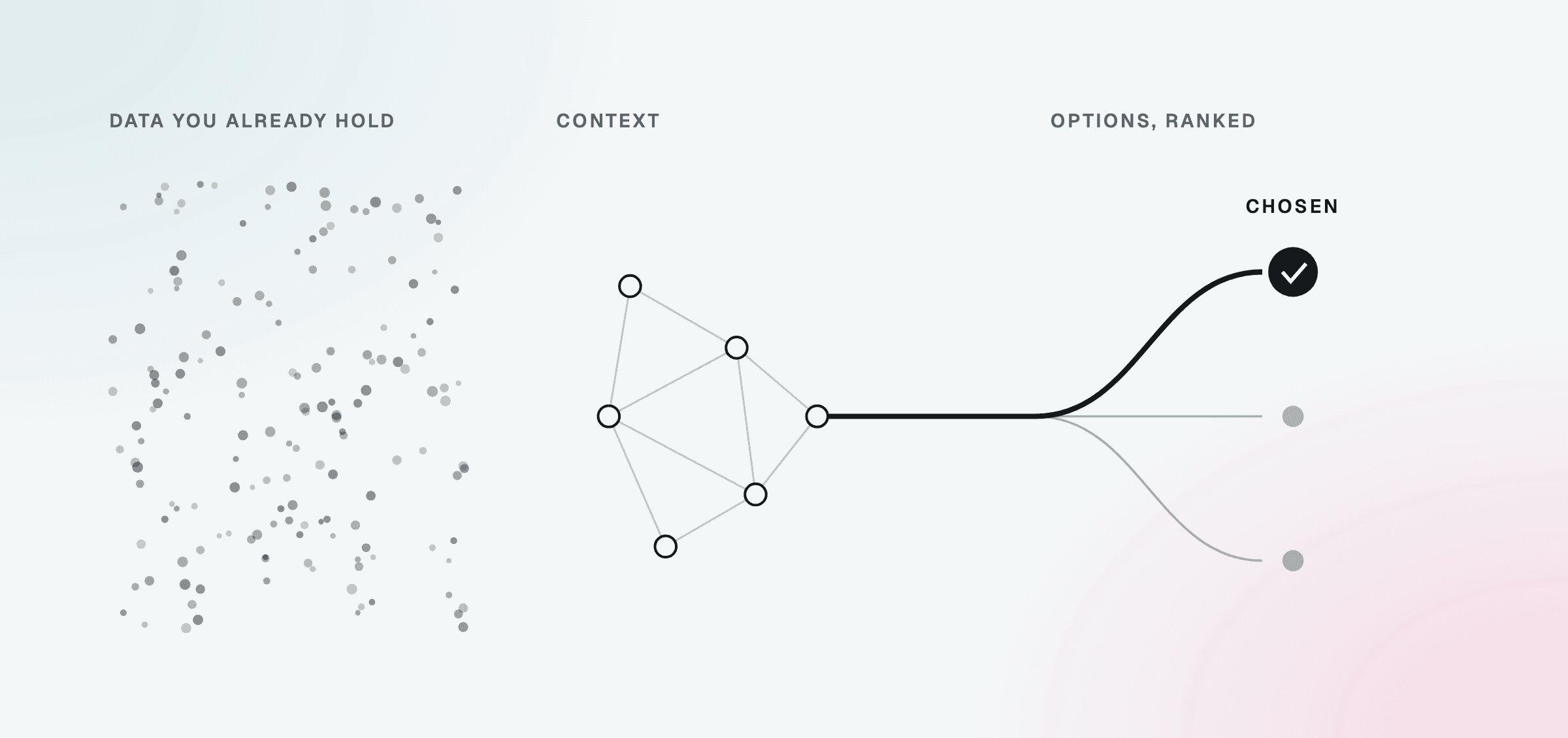
Decision intelligence connects the data you already hold to the decisions you have to make, so an answer arrives with its evidence and its limits attached.

A discipline from 2018 that became a software market in 2026.
Decision intelligence is the practice of connecting the data a business already holds to the decisions it has to make, so that an answer arrives with its evidence, its reasoning and its limits attached. It started life as a way of thinking about how people decide, and it has since become a category of software as well. Those two meanings are worth keeping apart, because the older one explains what the newer one is supposed to be for. Our CEO Yiannis Maos has written the long version of why this matters in data rich, insight poor, and this page is the shorter answer to what the category is.
Where did the term decision intelligence come from?
Decision intelligence is a term that traces all the way back to 2018, and to one person inside Google. That's where Cassie Kozyrkov was the company's first Chief Decision Scientist at the time. It's also where she built a new discipline, called it decision intelligence engineering, and taught its principles to more than 20,000 Google staff.
That first version revolved around people, and it was framed around building decision intelligence frameworks rather than software. Questions like how someone frames a question in the first place, how they work out in advance what evidence would be enough to change their mind, and how they act while the answer is still incomplete. Data science was the input and the decision was the subject. In practice the frameworks did four things: name the outcome you want, name what you are assuming, name what would prove you wrong, then go and get the data that settles it.
Then the software industry took the name, and by early 2026 Gartner had published its first Magic Quadrant for decision intelligence platforms, ranking vendors from Leaders through Challengers to Niche Players. It is now a category with its own scoreboard, and a lot of new entrants, Unloq among them, are building what decision intelligence looks like today and what it looks like tomorrow.
Even though a great deal has changed between 2018 and today, the core concept still holds: you make better decisions once you understand how you are making them. What has changed since is that the understanding can be built into a system, because AI and machine learning can support the reading of the documents, the models can carry the uncertainty, and the algorithms can rank the options against the constraints you set. The frameworks stopped being something a person had to hold in their head and became something a platform can run.
What does decision intelligence officially mean?
The category does have an official definition, and it is the one the market works from. Here is how Gartner's report describes a decision intelligence platform:
Software that helps organisations design, execute, monitor, and govern decisions end to end, using a combination of data, analytics, AI, rules, and human judgement.
Read through that and two words stand out: govern and human judgement. Yet those are the two that most organisations in the decision intelligence space only gloss over, as they prioritise automation and speed with AI instead of governed decision-making and human judgement. For us at Unloq the definition reads differently, as we put the emphasis back on those two words and have them at the centre of what we are building.
Govern means an answer can be traced, checked and refused. Traced back to the table and the document it came from, checked before anyone sees it, and refused when the data will not carry it, because a system that never declines cannot be believed when it agrees.
Human judgement is the part that turns a confident guess into a decision you can stand behind. Most consequential calls are made before the evidence is complete, by someone experienced enough to usually be right, and no record of the reasoning survives it. The platform gets you to the point of decision with the options ranked, the evidence attached and its own confidence stated, and then it stops, because the call belongs to whoever is accountable for it. Automation of the analysis, not of the accountability.

Decision intelligence and business intelligence: what is the difference?
Business intelligence describes the past and hands you the interpretation. Decision intelligence takes the question you asked, answers it against your own data, and keeps the reasoning so the same question does not have to be rebuilt six months later.
Business intelligence | Decision intelligence | |
|---|---|---|
The question it answers | What happened | What should we do about it, and did it work |
What it reads | Structured data, mostly your warehouse | Structured data alongside the documents, notes and definitions that explain it |
What comes back | A chart you interpret | An answer in the words you asked, with the sources named |
Who can use it unaided | Someone who already knows what to look at | The person who has to make the call |
What survives afterwards | The dashboard | The question, the sources, the confidence it carried, and who asked |
The last row is the one that matters. A dashboard is a view that gets rebuilt on demand, whereas almost no organisation keeps a record of the decision itself, which is a gap we have written about on its own page.
How is decision intelligence supported by AI and machine learning?
Machine learning is one of the techniques decision intelligence uses, and it belongs at one specific point in the chain. The model produces a prediction. A decision intelligence platform such as Unloq then works out what that prediction means for the specific call in front of you, weighs it against the constraints you have set, and keeps the trail of what it asked and what came back. Plenty of organisations run a great deal of machine learning without a decision ever coming out of the far end, because the models are used to automate a task, score a list or produce a forecast nobody acts on. That is the more common condition in the businesses we meet. The reason is usually context rather than compute, which is the argument Yiannis makes at length in why AI on its own will not fix this.
How does decision intelligence work?
At Unloq it happens in four steps, and this is worth reading as an example rather than a programme. It runs on the frameworks and the data you already have, so everything keeps running as it does today and the only difference is that four things start happening on top of it.
Connect. Read-only access to the systems you already run. Nothing is written back, and no record changes because a question was asked.
Sense. Unloq builds the picture of what your business is, how it runs and what has changed. Your tables get read alongside the documents and notes that explain them, which is the half most tools skip.
Recommend. Your options, ranked, each with a confidence level and the evidence behind it.
Prove. What you expected, set against what happened, so a call can be reviewed a year later by someone who was not in the room.
Underneath those four steps the capabilities are ordinary enough to describe in a sentence each. You ask in plain language and the answer names the table, the document and the page it came from, so the analyst sent to check has somewhere to go. The platform watches what has changed inside your systems and brings outside market signals in alongside it, forecasts across weighted scenarios instead of committing to one number, and raises the things you did not think to ask about. Every question, its sources, the confidence it carried and the name of whoever asked it gets kept from the first day.
The individual modules doing this work have names and you will hear them in a demo, though they are the wrong level of detail for a page about the category. The platform pages carry them, and the use-case pages put the same capabilities against a specific decision.
The four levels of decision intelligence
Most conversations about this category collapse into one question, which is whether the software can tell you what to do. Thinking in levels is more useful, because organisations are spread across all four of them and knowing which one you are on tells you what to ask a vendor for.

Level one is description and diagnosis. You ask questions of your own data in plain language and get cited answers back, including the ones that admit where the data is thin: why margin moved in the north region, which accounts drove the shortfall, what has changed since March. Most organisations are not yet here, because their reporting answers what happened and stops there.
Level two adds context. The platform knows what your business is, so it reads the contract alongside the revenue line, the policy alongside the exception, and the note explaining why one region counts things differently. Take a fall in margin, an example Yiannis uses. In one company that is a warning sign, and in another it is entirely expected because prices were cut on purpose to win share. Same data, different meaning, and nothing in the numbers tells you which one you are looking at. The answers improve because the definitions get reconciled at the point the question is asked, which is where decision intelligence separates from reporting.

Level three brings prediction and recommendation. Forecasts arrive as ranges with the confidence attached, and options come ranked against the constraints your business really operates under, with what each is likely to be worth. The organisations reaching for this are the ones already comfortable at level two, because a recommendation built on definitions no one trusts is worse than none at all.
Level four closes the loop. It is where, six months later, you can see what a decision was expected to deliver, what it actually delivered, and how far apart those two turned out to be. We call this the Impact Ledger, and the point of it is that every decision you make sharpens the next one. Level four comes last for a reason, which is that the record has to be reliable before any measurement built on top of it means anything.

Level four is also where we rejoin the 2018 idea from Google. That discipline asked what evidence you would need in order to decide better next time, and a closed loop is the same question answered automatically, out of work you were already doing. This is the level almost everyone in the market is missing, and it is the level we are building.
What makes decision intelligence governed?
Governance is the weakest part of this category and the first thing a finance director asks about. In practice it means four working mechanisms.
A validation check on every figure before anyone sees it. Each number is graded pass, warn or block against the query that produced it. Anything Unloq cannot trace back gets held.
Citation as a contract. An answer names its sources or it does not ship. A claim you cannot follow back to a table and a document is a claim you should not put in front of a board.
Guardrails on recommendations. Hard constraints, set by you. A recommendation that would breach one is suppressed and flagged for a person, and no action fires on its own.
A straight no. When the data will not support a confident answer, Unloq says so and names the gap. As Yiannis puts it, confidence and accuracy are not the same thing, and a well-written answer can feel authoritative while the reasoning behind it is weak.
On where your data sits, there are three real answers and any vendor giving you one unconditional answer is overstating it. Unloq works inside your existing environment, keeping sensitive data where it belongs while still giving the platform access to what it needs. That can be your own cloud, a dedicated environment we host and connect to your systems, or self-serve on our platform in a private, isolated and encrypted space. Access is read-only in all three, everything is encrypted in transit and at rest, and customer-managed keys are available.
Who is decision intelligence for?
Decision intelligence works for anyone who has to make a call before they can see the full picture, and who wants to be confident in it anyway. We think that describes most people with a budget, a decision in front of them, or a board to answer to. Every organisation has these people, and you are probably one of them.
Most organisations are data-rich and insight-poor, a problem our CEO Yiannis Maos has written about at length in how to solve the age-old problem of being data rich and insight poor. They hold enough data to be worth reading without the analytical capacity to keep up with the questions being asked of it, which describes a great deal of the mid-market and upper mid-market: businesses with an ERP, a finance system, a CRM and fifteen years of documents, and two or three people who know how it all fits together. Decision intelligence is what turns that holding into something the leadership team can use while a decision is still open.
Reactions to it tend to split, and both are reasonable. Some people read a page like this and recognise the thing they have wanted for years, while others get more cautious the more capable it sounds, because these decisions carry real weight and handing any part of them to software is not a small step. The second reaction is the reason governance appears on this page as four working mechanisms instead of an adjective.
Four functions feel it differently, and the questions they bring differ. A strategy owner has the reporting and the experience but the two do not meet in time for the decision, so what they need is an answer they can stand behind in the room without waiting a week for someone to build it. A finance director wants to know what a decision was worth and whether the number will survive being questioned, which makes them usually the second reader of anything like this and the first to ask how a figure was derived.
Data and analytics teams absorb every one-off request that comes in, and what decision intelligence is aimed at is the queue in front of them, so routine questions stop pulling them off the work only they can do. Operations has to act once the decision is made and mostly wants one shared version of the picture, so the conversation can move on to what happens next without restarting on whose numbers are right.
Two groups will not get much from it. Organisations that make one high-stakes decision a year are better served by the frameworks alone, and organisations that want the software to make the call will be disappointed, because it is built to stop at the point of decision and hand over.
Who sells decision intelligence?
The seventeen vendors Gartner assessed are largely enterprise software companies, several of them decades old, selling to organisations that already have an internal governance function and a data team to run the platform. Underneath the single label they arrive from three different directions, and the difference shows up in what you have to build before anything works at all.
Platforms that grew into the term from an adjacent category. Data and analytics platforms have added decisioning on top of what they already sold. If your data already lives there, that is a short path. If it does not, the platform expects you to bring it, and the migration becomes the project.
Some grew out of rules and risk engines. These are long-established and strong on high-volume automated decisions like credit and claims, built for a decision that repeats thousands of times a day. A leadership team making twenty consequential calls a quarter is a different problem.
Platforms built for this from the start, which is where Unloq belongs. The design constraint we set ourselves was that decision intelligence should not require a particular stack underneath it. Unloq connects read-only to what you already run, and it does not care whether that is AWS, Azure, Databricks or a finance system no one has touched in six years. Nothing gets shoehorned on top of a reporting tool, and nothing has to be centralised first.
Unloq is not in the Gartner ranking, and we would rather say so here than have you find it out later. The report covers seventeen established vendors and we raised seed funding in May 2026, so being absent from it is the expected result.
How do you adopt decision intelligence?
You do not begin with a rollout, and you do not begin with a platform evaluation either. Begin with one decision that is already on your desk.
Take the call you have to make at the next board meeting or in the coming budget round, and ask three questions about it. None of them need a vendor in the room. What data would settle this, and where does it live? Who would have to be in the room to interpret it? And if this call turns out to be wrong in nine months, what would we have written down that tells us why we made it?
Most teams find the third question the uncomfortable one. That is the gap decision intelligence is named after, and you can measure it before you buy anything.
Once you do bring vendors in, give each of them that one decision and ask them to answer it. Four things are worth comparing in what comes back: whether the answer cites its sources, whether the vendor will tell you in writing which of their capabilities are live today, what happens when the data will not support an answer at all, and who is accountable for the call once the software has spoken. A vendor who cannot answer the last one is selling you automation and calling it intelligence.
Decision intelligence: questions we get asked
Who coined the term decision intelligence?
Cassie Kozyrkov, at Google in 2018, as the company's first Chief Decision Scientist. The discipline she built was about how people make decisions with data. The software market adopted the name afterwards, and Gartner ranked that market for the first time in early 2026.
Is decision intelligence just a rebrand of business intelligence?
No, though plenty of business intelligence products now carry the label. The test is what survives after the question is answered. Business intelligence leaves a dashboard. Decision intelligence leaves the question, the evidence, the confidence it carried and the name of whoever asked, which is what makes a decision reviewable a year later.
Is decision intelligence the same as AI governance?
No, and the two get conflated constantly. AI governance checks whether a model behaves itself: bias, drift, compliance, whether the thing is safe to run. Decision intelligence checks whether a business decision was any good. They are different problems with different buyers, and a tool built for one will not cover the other.
Do we need to fix our data first?
No, and waiting for clean data is how three years go by. Unloq connects read-only to what you already run and reconciles the definitions at the point the question is asked, which is why fragmented, post-acquisition data is the case it is built for.
Do we need a data team to use decision intelligence?
You do not need one to use it. Questions are typed in plain language and answers come back cited, so the work that normally goes into raising a data request disappears. A data owner is involved at the start, when systems get connected and the limits are set, and much less after that.
How long before we see anything?
The software installs in about two weeks. A first decision running live takes three to ten weeks depending on how many systems are in scope, and the gating factor is usually your own security review. Full value lands at about a quarter, because the diagnostics sharpen as the platform learns how your business works.
Does decision intelligence replace the decision maker?
It is not built to. Unloq gets you to the point of decision with the options ranked, the evidence attached and the confidence stated, and then stops. Nothing fires on its own, and a recommendation that would breach a constraint you have set is held back for a person.
Ready to explore decision intelligence?
Start with a chat. Bring one decision that matters to you and we will work through it together: what data would settle it, where that data lives, and what an answer would need to carry before you would act on it.
If answering it properly needs access to your own data, we will tell you exactly what that would take before you commit to anything. Asking costs nothing, and you can ask us a question in writing first if a call is the wrong place to start.